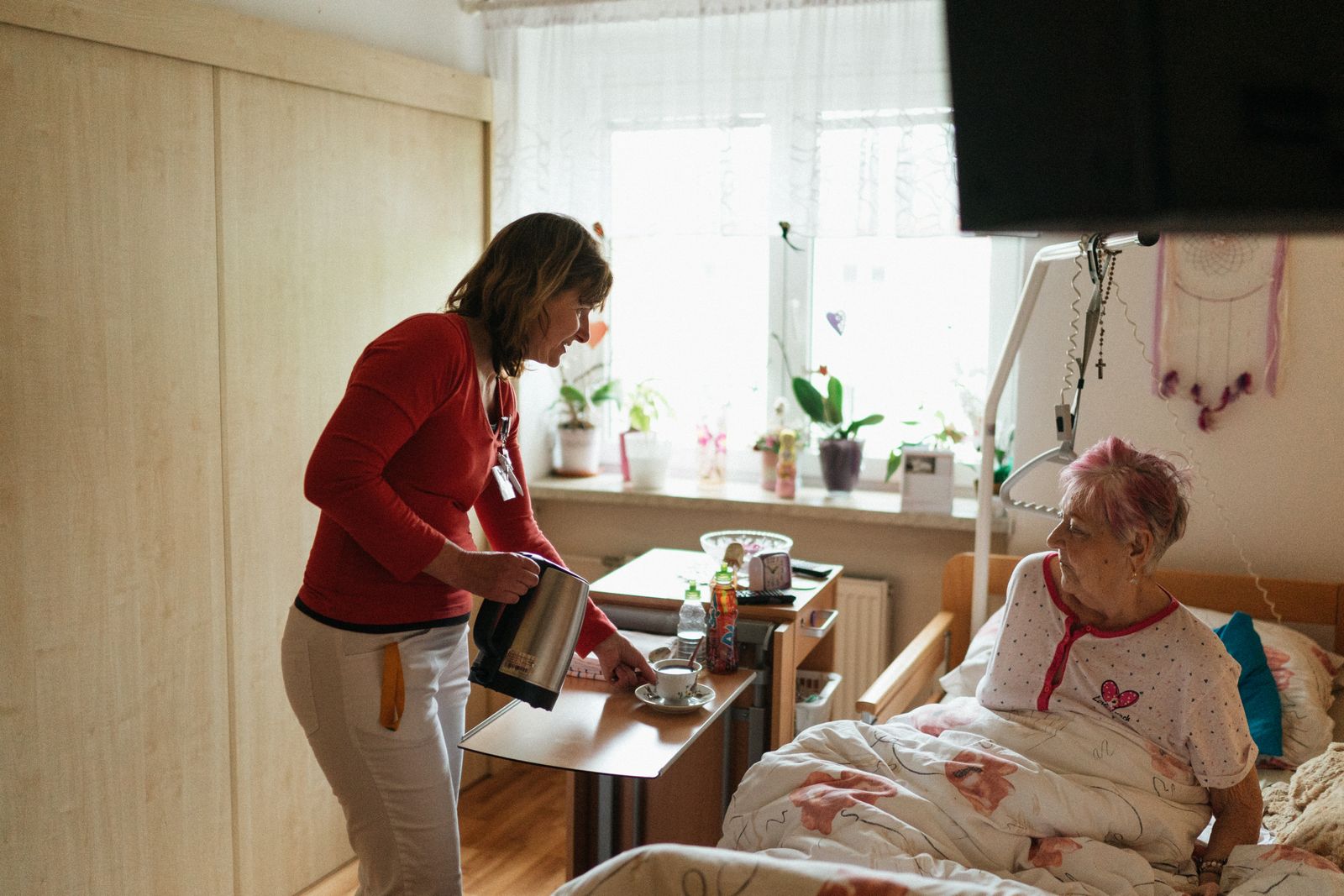
Memory care is specialized long-term care for people living with Alzheimer’s disease or another form of dementia. It combines a secure setting, 24-hour supervision, staff trained in dementia care, help with daily tasks and structured activities designed for people with memory loss. It is usually offered in a locked or secured wing of an assisted living community, though some memory care communities are standalone buildings, and some nursing homes have dedicated dementia units.
Below we explain what memory care includes, how it compares with assisted living and nursing homes, the signs it may be time, what a typical day looks like, what it costs, and exactly what to ask when you tour a community.
What memory care means, in plain terms
Dementia changes what a person needs from a home. Early on, many people do well with reminders, a pill organizer and a family member checking in. As the disease progresses, the main risks shift: getting lost, leaving the stove on, missing medications or doubling them, falls, poor nutrition, and the strain on a spouse or adult child who is providing care around the clock.
Memory care is built around those risks. The physical space is designed to keep residents safe without making them feel confined, the staff are trained to respond to confusion and agitation calmly, and the daily schedule is structured to reduce anxiety. The goal is not just safety but a good quality of life: purpose, routine, social contact and dignity.
The need is large and growing. The Alzheimer’s Association estimates that 7.4 million Americans age 65 and older are living with Alzheimer’s in 2026, about 1 in 9 people in that age group, and nearly 13 million Americans provide unpaid care for someone with Alzheimer’s or another dementia.
Where memory care is offered
- A secured unit inside an assisted living community. This is the most common setup. Residents live in a separate wing or floor with controlled exits, and the community may let a resident move from assisted living to memory care as needs change.
- A standalone memory care community. The whole building is designed for dementia care, often with circular hallways, enclosed courtyards and smaller “households.”
- A dementia unit in a nursing home. Some skilled nursing facilities have special care units for residents who need both dementia care and ongoing skilled nursing.
- Part of a continuing care retirement community (CCRC). Some CCRCs include memory care as one level on a single campus.
Not sure memory care is the right level?
Answer a few questions about your loved one’s needs and we’ll help you see which type of care fits, and what it costs near you.
Take the free care quizWhat services does memory care include?
Every community packages services a little differently, but a licensed memory care program typically includes the following.
| Service | What it looks like day to day |
|---|---|
| 24/7 supervision | Awake staff on duty day and night, with regular checks. Night staffing matters because many people with dementia are restless or up after dark. |
| Secured environment | Keypad or alarmed exits, enclosed gardens, wander-alert systems and layouts that let residents walk freely without reaching a dead end or an unsafe exit. |
| Dementia-trained staff | Caregivers trained in communication, redirection, managing agitation and recognizing pain or illness in someone who cannot describe it. |
| Help with activities of daily living (ADLs) | Bathing, dressing, grooming, toileting, continence care, eating and moving from bed to chair. |
| Medication management | Staff store, give and record medications, and watch for side effects. Rules on who can give medications vary by state. |
| Meals and nutrition | Three meals a day plus snacks, often with finger foods, contrasting plates, cueing at the table and help with eating. Hydration is tracked. |
| Structured activities | Music, reminiscence, art, gentle exercise, gardening, sensory activities and simple household tasks such as folding laundry, scheduled across the day. |
| Housekeeping and laundry | Room cleaning, linen changes and personal laundry. |
| Care coordination | Care plans reviewed regularly, communication with families, and arranging visits from doctors, therapists, podiatrists or hospice when needed. |
What memory care usually does not include is the level of skilled medical care a nursing home provides, such as complex wound care, IV therapy or ventilator support. Some communities have a nurse on site every day; others have nurses on call. Ask.
Memory care vs assisted living vs nursing homes
Families often weigh these three options at the same time. The biggest differences are security, staff training, medical care and cost.
| Feature | Assisted living | Memory care | Nursing home |
|---|---|---|---|
| Who it serves | Older adults who need some help with daily tasks but are mostly safe on their own | People with Alzheimer’s or other dementias who need supervision and a secure setting | People who need 24-hour skilled nursing or significant medical care |
| Security | Open campus, residents come and go | Secured exits, wander-alert systems | Varies; dementia units are usually secured |
| Staff training | General caregiver training | Dementia-specific training, often required by state rules | Licensed nurses and certified nursing assistants; dementia training required under federal rules |
| Medical care | Limited; nurse may be on call | Limited to moderate; some have daily nursing | 24-hour licensed nursing, RN on site at least 8 consecutive hours a day |
| Activities | Social calendar, outings | Structured, small-group, dementia-adapted | Activity program, often less personalized |
| Who regulates it | States | States | States plus federal CMS rules for Medicare and Medicaid certified homes |
| National cost (2025 to 2026) | $6,200 a month median (CareScout 2025) | $6,690 a month median (A Place for Mom 2026) | $315 a day semi-private, about $9,580 a month (CareScout 2025) |
| Medicaid coverage | Services only, through state waivers | Services only, through state waivers | Can cover the full cost for eligible residents |
Sources: CareScout Cost of Care Survey 2025; A Place for Mom 2026 Costs of Long-Term Care and Senior Living Report; 42 CFR 483.35; NCOA.
If your loved one has advanced dementia plus serious medical needs, read our full comparison of memory care vs a nursing home. If they are earlier in the disease and mostly independent, our guide to independent living vs assisted living explains the lighter-touch options.
Who needs memory care? Signs it may be time
A dementia diagnosis alone does not mean someone needs memory care right away. The question is whether they can be safe and well cared for where they are now, and whether the people caring for them can keep going. These signs suggest it is time to look seriously:
Safety signs
- Wandering or getting lost. The Alzheimer’s Association says six in 10 people living with dementia will wander at least once, and many do so repeatedly. Warning signs include trying to “go home” when already home, pacing and getting lost on familiar routes.
- Leaving the stove, water or doors on or open.
- Falls, unexplained bruises or new mobility problems.
- Missing medications, taking the wrong dose, or refusing medications.
- Unsafe driving, or getting lost while driving.
- Falling for scams or making unusual financial decisions.
Health and daily living signs
- Weight loss, spoiled food in the fridge or forgetting to eat.
- Poor hygiene, wearing the same clothes for days, or incontinence that is not being managed.
- Sleep disruption, nighttime confusion or “sundowning” (agitation in late afternoon and evening).
- Growing isolation, depression or anxiety.
- Aggression or behaviors that a current assisted living community says it can no longer manage.
Caregiver signs
- The primary caregiver is exhausted, ill or has had their own health decline.
- Nobody in the home is getting a full night’s sleep.
- Care needs now exceed what family and paid help at home can cover safely.
If you are not ready for a move, short-term respite stays in memory care or in-home and respite care can give a caregiver a break and let your loved one try a community before committing.
Staffing and state regulation basics
There is no single federal rulebook for assisted living or memory care. Each state licenses these communities and sets its own rules on staff training, staffing levels, building security and what a community must disclose before it can advertise dementia care. Nursing homes are different: those certified for Medicare or Medicaid must also meet federal CMS requirements, including licensed nursing 24 hours a day and a registered nurse on site at least 8 consecutive hours a day, 7 days a week.
Here are three examples of state dementia rules we verified:
| State | Rule | What it requires |
|---|---|---|
| California | Health and Safety Code section 1569.626 (residential care facilities for the elderly) | Direct care staff need 12 hours of dementia care training in their first year: 6 hours before working alone with residents and 6 more within the first four weeks. They then need 8 hours of dementia in-service training every year. |
| Illinois | 77 Ill. Admin. Code 973 (Alzheimer’s Disease and Related Dementias Services Act) | Staff with direct access to residents with Alzheimer’s or a related dementia need at least 6 hours of initial training within their first 60 days, then 3 hours of advanced training each year. |
| Texas | 26 Tex. Admin. Code 553.27 | An assisted living facility that advertises or promotes specialized Alzheimer’s care, for the whole building or a unit, must be a licensed Type B facility and hold Alzheimer’s certification from Texas HHSC. Certificates last three years and require an on-site inspection. |
Sources: California Health and Safety Code 1569.626; Illinois Administrative Code Title 77 Part 973; Texas Administrative Code Title 26 Section 553.27.
Staffing ratios are another area where states differ, and many states do not set a fixed ratio for assisted living at all, requiring “sufficient” staff instead. That is why it pays to ask each community for its actual day and night ratios. Rules change, so confirm the current requirements with your state’s licensing agency.
What a typical day in memory care looks like
Good memory care runs on routine. Predictable rhythms reduce anxiety and help residents feel oriented even when short-term memory is failing. A typical weekday might look like this:
| Time | What happens |
|---|---|
| 7:00 to 9:00 am | Staggered wake-ups based on each resident’s habits, help with bathing and dressing, morning medications |
| 8:00 to 9:30 am | Breakfast in a small dining room, with cueing and help with eating as needed |
| 10:00 am | Gentle exercise or a walk in the secured garden |
| 11:00 am | Small-group activity: music, reminiscence, sorting or folding tasks, art |
| 12:00 pm | Lunch, then rest time |
| 2:00 pm | Afternoon activity, visits from family, pet therapy or a sensory session |
| 3:30 to 5:00 pm | Calming activities planned for the sundowning window: quiet music, snacks, hand massage |
| 5:00 pm | Dinner and evening medications |
| Evening | Low-key activities, help getting ready for bed, overnight checks and continence care |
Residents are not forced into every activity. Strong programs adapt to the person: a retired teacher might help “set up the classroom,” a former mechanic might sort nuts and bolts. Ask how a community learns a new resident’s life story and uses it.
Get matched with memory care that fits
Tell us about your loved one’s diagnosis, needs and budget, and we’ll point you to options worth touring.
Take the free care quizHow much does memory care cost?
Memory care costs more than assisted living because of the extra staffing, training and security. A Place for Mom’s 2026 report puts the national median for memory care at $6,690 a month, up 3.7% from $6,450 in 2025. For comparison, the same report puts assisted living at $5,419 a month, so memory care ran about 23% higher. CareScout’s 2025 survey, which does not track memory care separately, puts the assisted living median at $6,200 a month.
| Type of care | National median cost | Source |
|---|---|---|
| Memory care | $6,690 a month (2026) | A Place for Mom |
| Assisted living | $6,200 a month (2025) | CareScout |
| Nursing home, semi-private room | $315 a day, $114,975 a year (2025) | CareScout |
| Nursing home, private room | $355 a day, $129,575 a year (2025) | CareScout |
| Non-medical in-home caregiver | $35 an hour (2025) | CareScout |
Sources: CareScout Cost of Care Survey 2025; A Place for Mom 2026 Costs of Long-Term Care and Senior Living Report.
Costs vary a lot by state and by city. For state-by-state figures, pricing models and hidden fees, see our full guide: how much does memory care cost.
How to pay for memory care
Most families use a mix of sources. The main options:
- Private funds. Savings, retirement accounts, pensions, Social Security and the proceeds of selling a home cover most memory care bills.
- Long-term care insurance. Most policies pay benefits when the policyholder has a severe cognitive impairment or needs help with two or more daily activities. Check the daily benefit, elimination period and whether the community must be licensed.
- VA Aid and Attendance. Wartime veterans and surviving spouses who need help with daily activities may qualify for this pension add-on. Effective December 1, 2025, the maximum annual pension rate with Aid and Attendance is $29,093 for a veteran with no dependents and $34,488 for a veteran with one dependent. See our guide to VA Aid and Attendance for assisted living.
- Medicaid waivers. Medicaid does not pay for room and board in assisted living or memory care, but many states offer home and community-based services waivers that cover care services, and some include memory care. Slots can be limited, with waitlists. Read does Medicaid pay for assisted living for how this works.
- Medicare. Medicare does not pay for long-term custodial care, including memory care room and board. It still covers doctor visits, hospital care, some therapy and hospice. More detail: does Medicare pay for assisted living for dementia.
- Other options. Life insurance conversions, bridge loans, reverse mortgages and family contributions can fill gaps.
Memory care fees may also be partly or fully tax deductible as a medical expense when a doctor certifies the resident as chronically ill. Our memory care cost guide covers the IRS rules.
Questions to ask on a memory care tour
Bring this checklist and visit at least twice, once at a mealtime and once in the late afternoon, when sundowning is most likely.
Staff and training
- What are your staff-to-resident ratios during the day, evening and overnight?
- How many hours of dementia training do new caregivers get before working alone, and how much each year?
- Is a nurse on site every day? Overnight? Who decides when to call a doctor or 911?
- What is your staff turnover rate? How long has the director been here?
Safety and environment
- How are exits secured? What happens if a resident gets out?
- Is there a secured outdoor area residents can use on their own?
- How do you prevent and respond to falls?
- Can I see your most recent state inspection report and any citations?
Care and daily life
- How do you build a care plan, and how often is it updated? Are families part of that meeting?
- How do you handle agitation, aggression or refusal of care? Do you use antipsychotic medications, and how do you try to avoid them?
- What does the activity calendar look like this week? How do you engage residents who will not join groups?
- How do you help residents who need help eating or have trouble swallowing?
- Can residents receive hospice here?
Money and contracts
- What is included in the monthly rate, and what costs extra?
- Is there a one-time community fee? Is any of it refundable?
- How often have rates gone up over the last three years, and by how much?
- Do you accept long-term care insurance, VA benefits or Medicaid waivers?
- Under what conditions would you ask my loved one to move out?
How to choose a memory care community, step by step
- Get a clear picture of needs. Ask your loved one’s doctor for a current assessment: dementia stage, mobility, medications, behaviors and any medical needs. This also helps with insurance and tax paperwork.
- Set a realistic budget. Add up income, savings, insurance and benefits, and work out how many years they will cover. Check VA and Medicaid eligibility early because applications take time.
- Build a shortlist. Search the memory care directory for licensed communities within easy driving distance for the family members who will visit most.
- Check licensing and inspection records. Look up each community on your state licensing agency’s website. Note any serious or repeat citations.
- Call first. Ask about pricing, availability, and whether they can meet your loved one’s specific needs, such as incontinence, a wheelchair or diabetes care.
- Tour in person, more than once. Use the checklist above. Watch how staff speak to residents. Are residents engaged, clean and comfortable, or parked in front of a TV?
- Talk to other families. Ask the community for references, and chat with visitors in the lobby if you can.
- Read the contract carefully. Look for the rate increase policy, what triggers a move to a higher care level, discharge rules and refund terms. Consider having an elder law attorney review it.
- Plan the move. Bring familiar items such as photos, a favorite chair and bedding. Ask the staff how they handle the first few weeks, which are often the hardest.
Compare memory care communities near you
Browse licensed memory care communities by state and city, and build your shortlist for tours.
Browse memory care near youFAQs
What is the difference between memory care and dementia care?
The terms are often used interchangeably. “Dementia care” describes any care for someone with dementia, including at home. “Memory care” usually means a residential setting, a secure unit or community, built specifically for people with Alzheimer’s and other dementias.
What stage of dementia is memory care for?
Most people move to memory care in the middle stages, when wandering, confusion, safety risks or care needs become too much to handle at home or in standard assisted living. Many residents stay through the late stages, often with hospice support.
Is memory care the same as a nursing home?
No. Memory care focuses on supervision, safety and daily support for people with dementia. A nursing home provides 24-hour skilled nursing and medical care. Some nursing homes have memory care units, and someone with dementia and serious medical needs may need a nursing home.
Does Medicare pay for memory care?
Medicare does not cover long-term custodial care or room and board in memory care. It does cover medical services, such as doctor visits, hospital stays, some therapy and hospice, while a person lives in memory care.
Does Medicaid pay for memory care?
Medicaid does not pay for room and board in assisted living or memory care, but many states have waivers that pay for care services in these settings. Eligibility, coverage and waitlists vary by state. In a nursing home, Medicaid can cover the full cost for people who qualify.
How much does memory care cost per month?
A Place for Mom’s 2026 report puts the national median at $6,690 a month. Prices vary widely by state, city and level of care, and memory care generally costs more than standard assisted living.
Can a person with dementia be forced into memory care?
An adult who has decision-making capacity can generally choose where to live. If dementia has removed that capacity, a person named in a health care power of attorney, or a court-appointed guardian, may be able to make the decision. Rules vary by state, so speak with an elder law attorney.
Can couples live together in memory care?
Some communities allow it, and others place a spouse with dementia in memory care while the other spouse lives in the assisted living or independent living section of the same campus. Ask each community what it allows and how it prices shared rooms.
How long do people usually stay in memory care?
It varies widely depending on when a person moves in and how their dementia progresses. Some stay a few months, others several years. Budget for the possibility of a multi-year stay.
What should I bring when my loved one moves into memory care?
Comfortable, labeled clothing, familiar bedding, family photos, a favorite chair or blanket, and a short life story for staff (career, hobbies, favorite music, daily habits). Leave valuables and important documents at home.
Find senior living near you
Ready to compare options? Browse assisted living, memory care, independent living and respite care communities, or explore senior living in Florida, Texas, California, Ohio, Illinois, Arizona, Pennsylvania and New York. You can also browse every state and city.